Bicycle accidents involving motor vehicles tend to cause more serious injuries than typical car-on-car collisions, simply because a cyclist has no metal frame protecting them. Arizona law gives cyclists specific rights on the road, and when a driver violates those rights and causes a crash, the cyclist generally has the same right to compensation as any other injured accident victim. Here’s how these claims typically work.

Do Cyclists Have the Same Rights as Drivers in Arizona?
Largely, yes. Arizona law treats bicycles as vehicles for most traffic law purposes, meaning cyclists are entitled to a share of the road and are subject to many of the same rules of the road as drivers. Drivers are required to give cyclists a specific minimum distance when passing, and violating that distance, or otherwise failing to account for a cyclist’s right to the road, can be strong evidence of negligence in a claim.
Common Causes of Bicycle Accidents
- Failure to yield, especially at intersections and when turning across a bike lane
- Dooring, when a parked car’s door opens into a cyclist’s path
- Unsafe passing, including passing too closely or without enough clearance
- Distracted driving, including phone use that delays a driver’s reaction time
- Failure to see a cyclist, particularly in low-light conditions or at intersections with obstructed sightlines
For a free legal consultation, call (602) 237-6772 today.
Why Bicycle Accident Claims Are Often More Complicated
Bicycle accident claims frequently involve disputes that don’t come up as often in typical car accident cases:
Comparative fault arguments. Insurance companies sometimes try to shift blame onto the cyclist, arguing they weren’t following bike lane rules, weren’t visible enough, or were riding outside a marked lane when it wasn’t required. Arizona’s pure comparative fault rule means you can still recover damages even if you’re found partially at fault, but the insurance company’s initial position is often more aggressive in these cases than in a typical two-car crash.
Injury severity and medical costs. Because cyclists lack a vehicle’s structural protection, injuries from even relatively low-speed collisions can be severe, including traumatic brain injuries, spinal injuries, and complex fractures. That often means higher medical costs and more contested arguments over long-term care needs.
Underinsured motorist coverage. If the driver who hit you has minimal insurance, your own underinsured motorist coverage, if you have it, may become a critical part of recovering full compensation.
What to Do After a Bicycle Accident
- Call 911 and get medical attention, even if you feel capable of continuing on; adrenaline can mask injury symptoms, and a documented medical record matters for your claim.
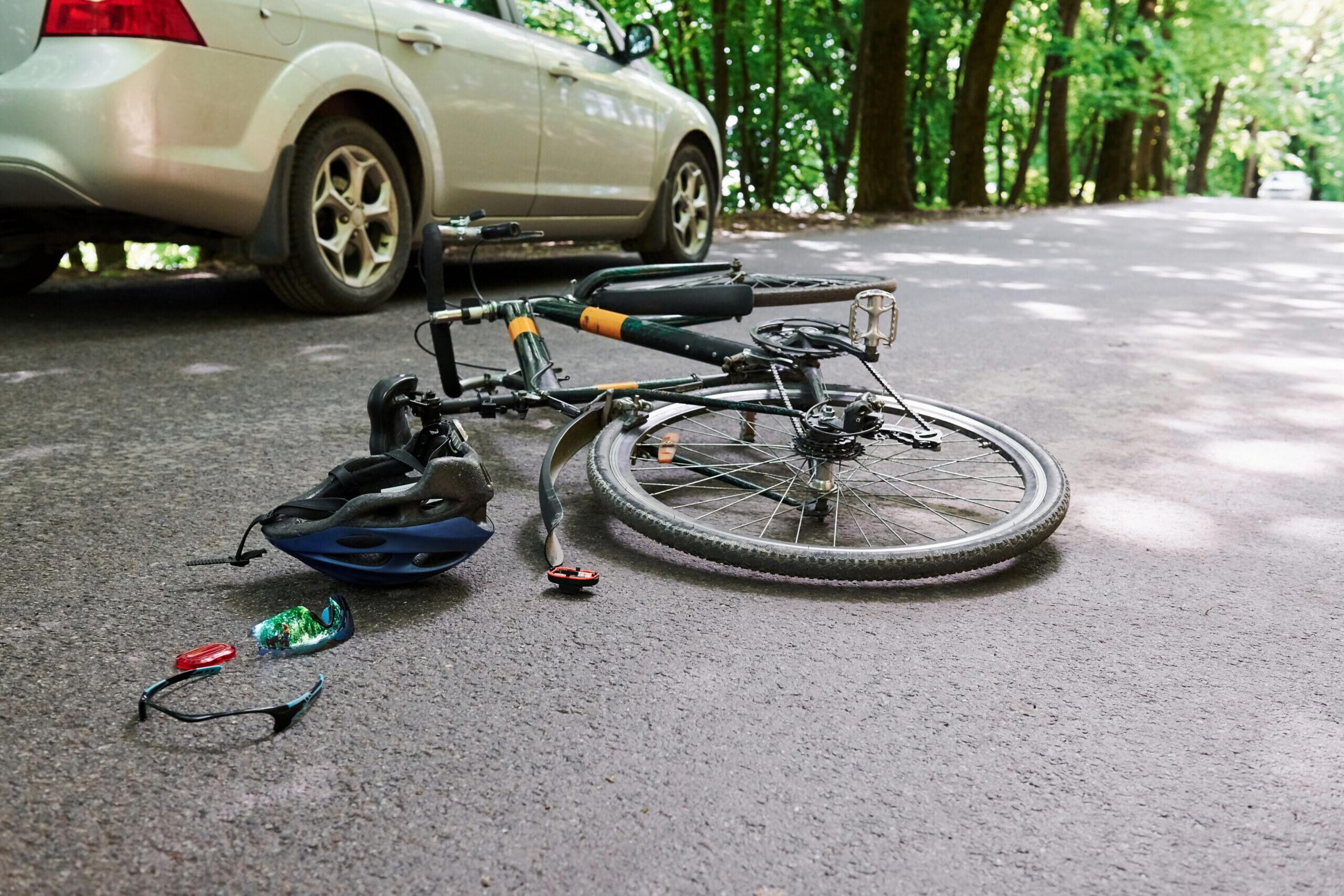
- Document the scene if you’re physically able, including the position of vehicles, any skid marks, road conditions, and your bicycle’s damage.
- Get the driver’s insurance and contact information, and identify any witnesses.
- Avoid discussing fault at the scene or giving a recorded statement to the driver’s insurance company before speaking with an attorney.
- Preserve your bicycle and gear exactly as they were after the crash; damage patterns can serve as evidence of impact and speed.
- Understand your legal obligations around the scene of the accident. See our related guide on Are You Allowed to Leave the Scene of an Accident in Arizona.
What Compensation May Be Available
Depending on the facts of your case, damages in a bicycle accident claim can include medical expenses (past and future), lost income, property damage to your bicycle and gear, and pain and suffering. Our broader guide on How Much to Expect From a Car Accident Settlement in Arizona covers the general factors that drive settlement value, many of which apply directly to bicycle accident claims as well.
When You Should Talk to a Bicycle Accident Attorney
Consider speaking with an attorney as soon as possible after a bicycle accident, especially if:
- You suffered any injury requiring medical treatment
- The insurance company is disputing fault or blaming you for the crash
- The driver fled the scene or was uninsured or underinsured
- You’re being pressured to settle quickly or give a recorded statement
Local Representation
Brandon White Law represents injured cyclists throughout Arizona, including Gilbert, handling claims involving distracted drivers, unsafe passing, dooring, and failure-to-yield collisions. For general accident representation beyond bicycle claims, see our personal injury resources.
Frequently Asked Questions
Who is usually at fault in a bicycle accident with a car?
It depends on the specific facts, but drivers are frequently found at fault for failing to yield, passing too closely, or not seeing a cyclist who had the right of way. Arizona’s comparative fault system allows recovery even if the cyclist bears some responsibility.
Can I still recover compensation if I wasn’t wearing a helmet?
In most cases, yes. Arizona does not have a statewide law requiring helmet use for adult cyclists, and even where helmet use is relevant, it typically affects the extent of injury rather than who caused the crash.
What if the driver who hit me doesn’t have insurance?
Your own underinsured or uninsured motorist coverage, if you carry it, may apply. An attorney can help evaluate what coverage is available and how to pursue it.
How long do I have to file a bicycle accident claim in Arizona?
Arizona generally applies a two-year statute of limitations to personal injury claims, though the clock and specific requirements can vary depending on who’s involved, including if a government vehicle or entity is a party.
Do I need a lawyer if my injuries seem minor?
It’s worth a free consultation regardless. Some injuries, particularly concussions and soft tissue injuries, don’t fully present until days or weeks later, and early legal guidance protects your ability to seek fair compensation if that happens.
If you’ve been injured in a bicycle accident anywhere in Arizona, contact Brandon White Law for a free consultation.
Call or text (602) 237-6772 or fill out our Free Case Evaluation form to get started.